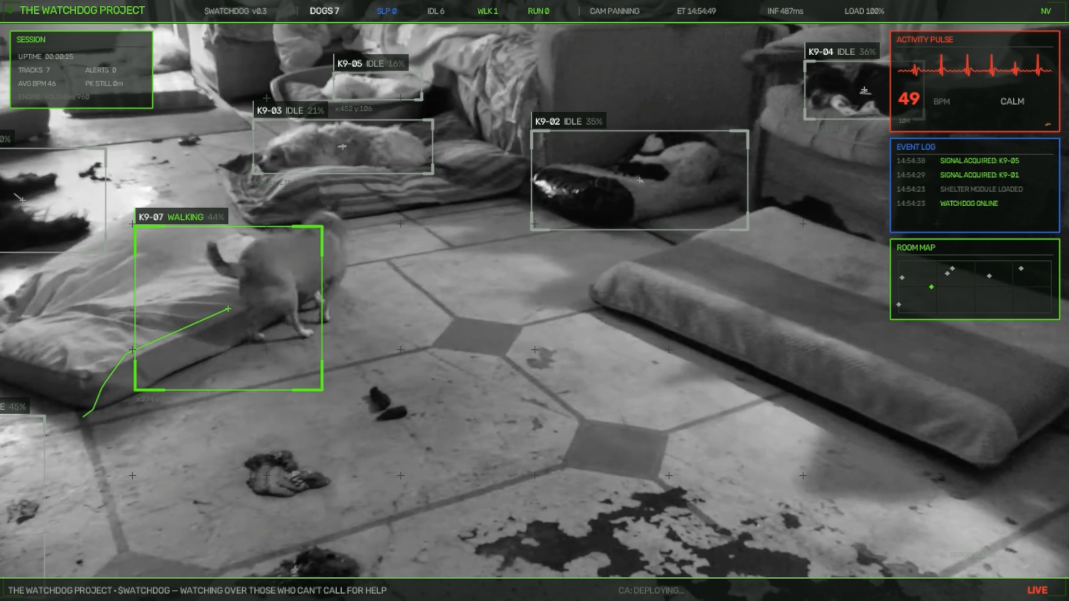
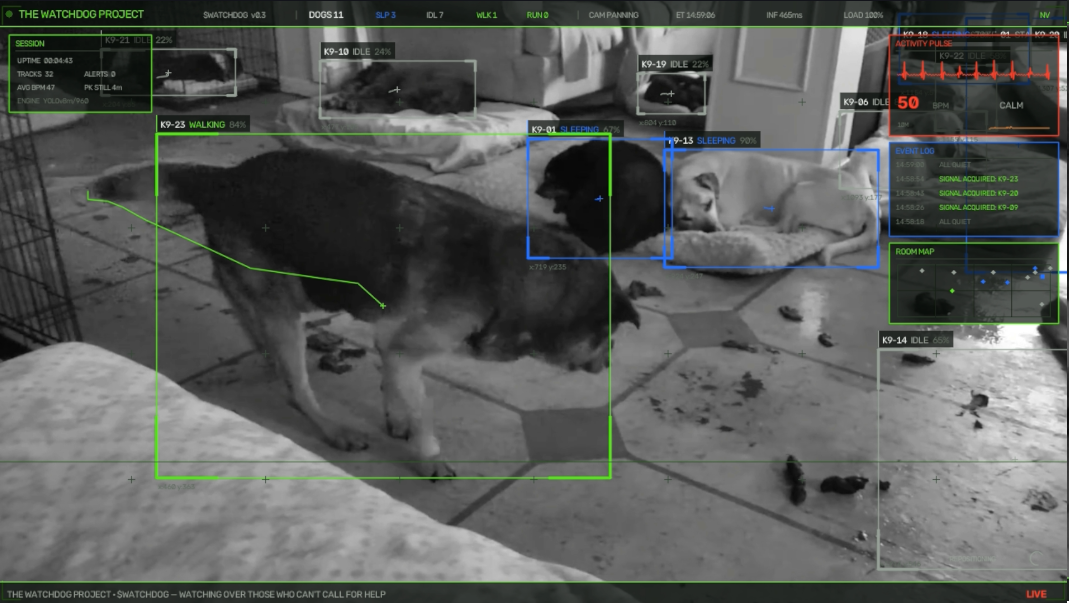
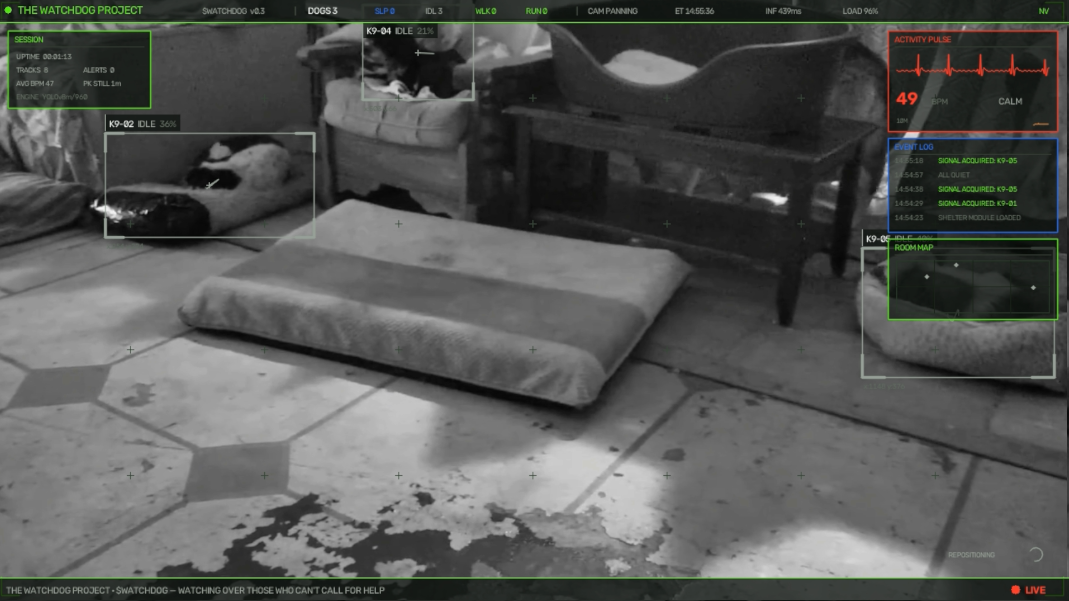
The Watchdog Project is a real-time computer vision layer built for animal shelters and home care of sick or disabled dogs. It plugs into ordinary security cameras, tracks every animal in the room around the clock, and raises the alarm the moment something stops looking normal. A significant part of the system is already built and running against real shelter footage. The rest is being funded and shipped in the open.
The first public technical demonstration of the Watchdog engine — a live, unscripted analysis session over real shelter night-camera footage — streams on pump.fun. What you'll see on screen is the actual system output: every box, every status, every heartbeat of the interface is computed in real time. Nothing staged.
OPEN STREAMShelters are understaffed. Night shifts are thin. A sick dog that stops moving in a corner kennel can go unnoticed for hours — and hours are what decide outcomes. Software doesn't blink, doesn't sleep, and doesn't get tired of watching.
Put a tireless, honest set of eyes on every shelter animal and every sick or disabled dog in home care — using the cameras people already own, on hardware they already have.
Detect the moments that matter: the dog that hasn't moved for too long, the sudden burst of distress activity, the quiet corner nobody checked. Then alert a human, fast, with evidence on screen.
A world where no shelter animal declines unseen. Where a rescue running on volunteers gets the same standard of overnight monitoring a modern ICU takes for granted — for free, funded by a community instead of a license fee.
Long term: an open monitoring layer any shelter on earth can point at their cameras. One protocol, thousands of rooms, every animal accounted for.
Shelter cameras are not studio cameras. The engine is built for black-and-white night vision, low contrast, curled-up sleeping animals, and lenses that slowly sweep the room. Every layer below runs today, in real time, on a standard CPU.
A tuned deep-learning detector, validated frame-by-frame against real shelter night footage. Multi-profile inference recovers animals that low-contrast IR video usually hides — including dogs curled up asleep, the hardest pose in the book.
A custom tracking layer maintains stable identities (K9-01, K9-02…) across minutes, not frames. Sleeping animals keep their track even when the detector only sees them intermittently; content verification silently clears stale boxes.
Sub-pixel ego-motion measurement keeps every track glued to the scene while the camera pans. Identities and immobility timers survive full sweeps of the room — even for animals that temporarily leave the frame.
Every animal carries a live immobility clock. Cross a configurable threshold and the system escalates: on-screen warning, red-flag status, audible alarm, logged event. This is the module that exists to save lives.
Room-wide activity rendered as a live vital sign — waveform, BPM and audio tick, driven purely by measured motion of tracked animals. Calm rooms read calm. Sustained agitation trips a high-activity alert. No synthetic data, ever.
A background-model layer locks onto any new movement in under a second and hands it to the detector for confirmation — so a dog getting up at 3 AM is boxed and labeled before it takes three steps.
Status strip, event log, room map radar, session statistics, per-animal state labels (SLEEPING / IDLE / WALKING / RUNNING) — a monitoring UI designed to be read at a glance from across a room, streamed as a live video feed.
Corrupt frames, stalled readers, dropped virtual-camera links — the runtime detects and repairs its own failure modes without human intervention. Designed to run unattended for days.
The v1.0 target: direct ingestion from standard shelter and home security cameras (RTSP/ONVIF-class streams), multi-room support, and remote alert delivery. The concept the whole project was started for — and the part your support ships.
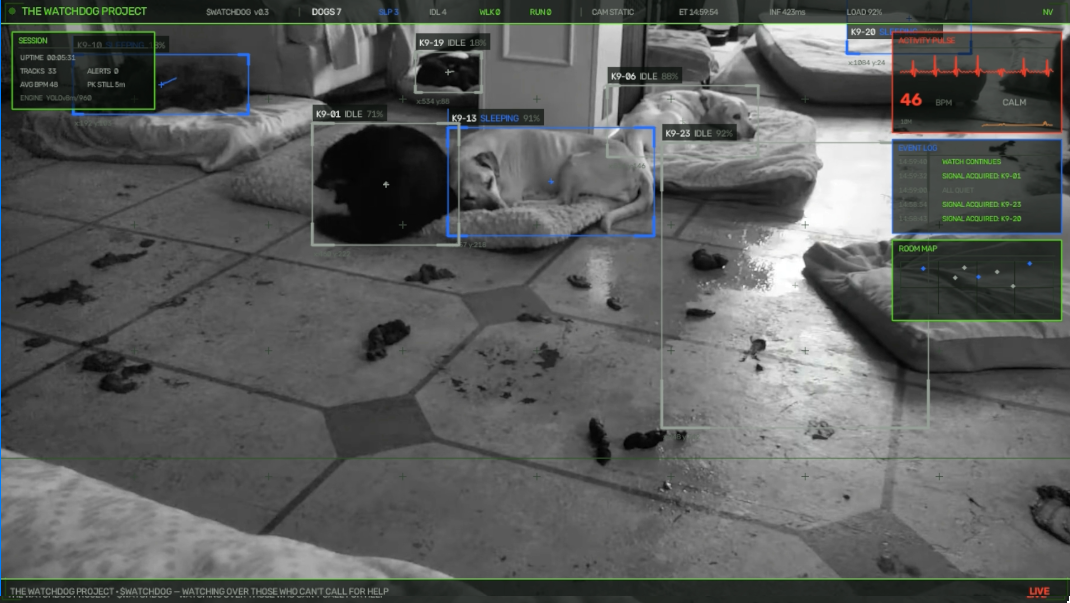
Every figure below comes from validation runs against genuine shelter night-camera footage — the same footage used in the live demonstration stream.
| Metric | Result |
|---|---|
| Detection uplift vs. baseline pipeline (24-frame validation set) | +73% |
| Sleeping / curled animals recovered in night IR | Majority coverage |
| Moving-animal lock-on latency (motion sentinel) | < 1.0 s |
| Inference cadence, CPU-only (no GPU present) | ~2.5 sweeps / s |
| Identity persistence through full camera pans | Maintained |
| Continuous immobility timing verified | 11+ min unbroken |
| Unattended soak test — crashes / faults / manual repairs | 32 min — 0 / 0 / 0 |
| End-to-end alert chain (label → log → flash → audio) | Verified |
| False vitals or synthetic data rendered on screen | None. By policy. |
Direct captures from the engine running against shelter footage. Every box, label, trail and vital on these frames was computed live by the system.
Excerpts from the production engine — enough to show how it thinks, not enough to hand the pipeline away. Full internals stay closed until the audit-ready release.
# Stillness escalation — the module that exists to save lives. # Every animal carries a live immobility clock; thresholds are # configured per facility. for track in confirmed_tracks: still_min = track.still_minutes(now) if still_min >= IMMOBILE_ALERT_MIN: log.add(f"CHECK RECOMMENDED: {track.label} {still_min:.0f}m", RED, cooldown=300) audio.raise_alarm() # double-tone, hard to ignore hud.flash_perimeter(5.0) # full-frame red strobe elif still_min >= IMMOBILE_WARN_MIN: log.add(f"STILLNESS WATCH: {track.label} {still_min:.0f}m")
# Cameras drift. Tracks must not. # Scene shift is measured sub-pixel against a rolling reference # frame, then applied to every track — identities and immobility # timers survive full pans of the room. (sdx, sdy), _ = cv2.phaseCorrelate(ref_frame, current_frame) if hypot(sdx, sdy) > NOISE_FLOOR: delta = to_full_res(sdx - applied.x, sdy - applied.y) world.shift_all_tracks(delta) # boxes, anchors, trails # [ redacted: reference cycling & residual transfer ]
# Sleeping dogs don't move — so intermittent detections are # fused into one persistent identity instead of flickering boxes. if track.is_stationary(): ttl = LONG_HOLD # patience for sleepers if track.content_changed(frame): # texture verification track.strikes += 1 # 3 strikes → box is stale, drop it else: ttl = SHORT_HOLD # movers must keep confirming
# ACTIVITY PULSE — honesty rule, enforced in code: # the vital sign is a metaphor rendered from MEASURED motion. # The system never fabricates a data point. Ever. act = max(tracked_speed_component, motion_field_component) act_ema = act_ema * 0.94 + act * 0.06 bpm_target = REST_BPM + act_ema * DYNAMIC_RANGE if act_ema > HIGH_ACTIVITY_FLOOR: # sustained, not spikes alerts.high_activity(room)
Core loop running on real shelter footage: detection, basic overlay, live virtual-camera output. Proved the idea works on ordinary hardware.
Full operator console: event log, activity pulse, alert engine, camera-motion handling, and the self-healing runtime layers.
Rebuilt detection and tracking stack: night-IR-tuned inference, persistent identities, ego-motion compensation, motion sentinel, stillness continuity through camera pans. This is the build shown in the live stream.
Direct RTSP/ONVIF-class ingestion from off-the-shelf security cameras, multi-room sessions, remote alert delivery (mobile push / messaging), configurable per-facility thresholds.
First real installations, free for participating shelters. The application program below opens the day v1.0 ships.
How this gets funded. The Watchdog Project is being announced through a community token launch — $WATCHDOG. Proceeds attributable to the project fund one thing: development. Camera integration, field hardware for pilot shelters, and the engineering hours between v0.3 and v1.0.
We keep it simple: the software already exists and you can watch it run live. The token is how a community puts a monitoring system into shelters that could never afford one. Contract address will be published here — until then, treat anything else claiming to be us as fake.
Two tracks, both free for participants. Applications open the day v1.0 ships — the forms below go live at launch and are shown here so you know what's coming.
For shelters and rescue organizations that want overnight monitoring on their existing camera systems. Pilot facilities get priority support and hardware help.
For owners caring for a sick, senior or disabled dog who need a tireless second pair of eyes — overnight, or while they're away at work.